Margin note
Completion is not readiness.
On the morning of 27 March 2008, the operators of Heathrow Terminal 5 had every reason to expect a quiet triumph. The building was a serious piece of civil engineering. The project had taken roughly twenty years from conception to completion — including a four-year public inquiry, with six of those years in construction — cost £4.3 billion, and arrived near enough to schedule and budget that the industry treated it as a rare success. Among megaprojects, that is close to mythical.
The seam worth watching in any project is the one where a finished structure meets a messy operating reality. A company can have a clean balance sheet and a working factory and still destroy capital, because nobody knows how to move the inventory on a Tuesday morning. The building is the easy part. It is inert, it holds still while you inspect it, and it does not have to coordinate with anything.
The institutional allocator looks at a finished building and sees an operational asset. The assumption is that if the concrete is dry, the escalators are running, and the inspector has signed off, revenue will begin to flow on the schedule in the model. That assumption confuses physical completion with operational readiness, and the two are separate milestones with separate failure modes.
The Opening Day Collapse
Terminal 5 was built to process tens of thousands of passengers and their luggage every day. On its first morning, the system ground to a halt within hours.
The bottleneck did not begin at the runways or inside the baggage sorting hall. It began at the staff car parks. Employees arriving for the early shift could not get into the parking spaces. When they finally parked and reached the terminal, they could not clear the staff security screening quickly, because the lanes and the systems behind them were not ready for the load.
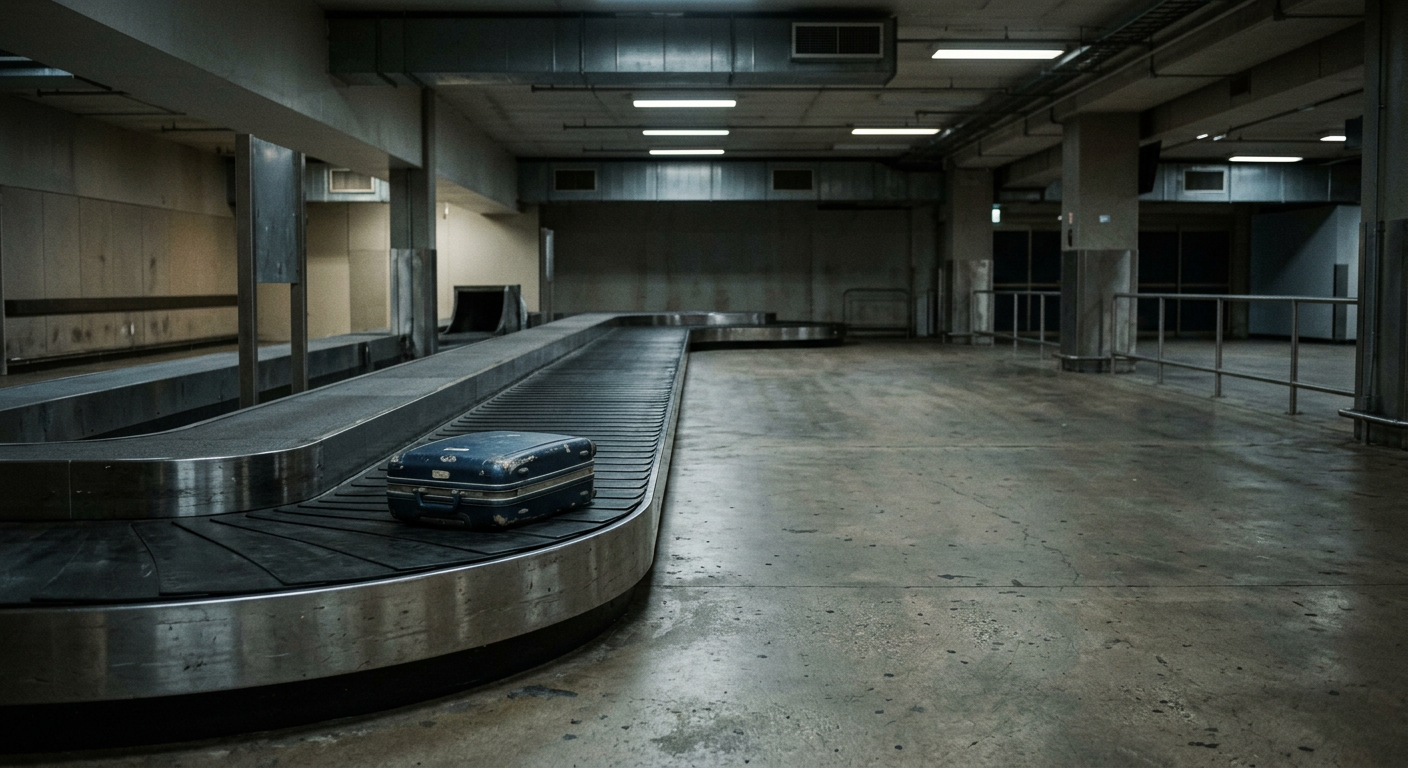
So the baggage handlers who were supposed to be loading departing flights were still outside the building while the bags were already arriving on the check-in belts. The automated baggage system, which had not been proven under full load, began to fall behind. The system could not reconcile incoming bags against departing flights when the handlers were not there to work them. By the afternoon, the airline was telling passengers to travel with hand luggage only.
The first ten days tell the rest. Sixty-eight flights were cancelled on day one. Over the first eleven days, 636 of 4,095 scheduled flights were cancelled — about 15% of the schedule — and British Airways told the inquiry that 23,205 bags were misconnected in the first five days. British Airways could not run its full schedule until 8 April. It put the cost of those first five days alone at £16 million, though outside estimates at the time ran higher, and that figure is thinner than the operational ones. Two senior executives — the director of operations and the director of customer services — left the airline within three weeks.
The Arithmetic of Rehearsal
The committee found two root causes: insufficient joint working between BAA and British Airways, and poor staff training and system testing. Genuine software faults existed too — sign-on tables, wireless coverage on seven stands — but they were the kind of defect an integrated live rehearsal is supposed to surface.
Before opening, BAA ran 66 proving trials with 15,000 volunteers and pushed 400,000 bags through the system. The scale was not the problem. The realism was: BAA's own chief executive later conceded the test baggage “was too uniform” compared with what real passengers actually check in, and the trials were watched by people whose job was to fix glitches on the spot.
You cannot rehearse a terminal of that size with baggage more uniform than the real thing. Volume and operational friction do not scale together in a straight line. Take the number of passengers from a few hundred to tens of thousands and the number of interactions between staff, IT, baggage belts, and security gates rises by orders of magnitude. The minor delay at the car park gate, which was a footnote during the trials, becomes the blockage that shuts the terminal down on opening day.
The planners had mistaken a series of successful sub-system tests for a test of the integrated system. They had verified that a belt could move a bag from A to B and that the staff database could record a name. They had not verified that staff could use the database to run the belt while a departures hall full of people waited.
The Commissioning Barrier
The same gap between built and ready shows up in every acquisition.
When a private equity firm buys a manufacturing business, it spends months auditing the machinery and reading the customer contracts. Physical assets and historical cash flows get examined closely, and the transition is assumed to be a matter of updating bank signatures. Then the deal closes, the founder walks out, and the warehouse discovers that nobody else knows the password to the shipping software. Trucks sit, orders slip, and the first quarter of the investment is spent paying consultants to reconstruct an inventory system that worked fine a month earlier.
The small allocator's edge here is the ability to wait through the transition. When underwriting a micro-cap that is launching a product line or commissioning a facility, the new cash flows do not belong in the next quarterly report. Assume the first six months are staff retraining, supply chain delays, and software patches, and size the position so that a temporary operational mess does not force a sale at the worst price. That is not cleverness; it is just refusing to model the easy part and skip the hard one.
The institutional money cannot buy that patience. It runs on a quarterly reporting cycle and its investors expect the transition to be seamless. When Terminal 5 collapsed, the executives went, not because the terminal was a bad asset, but because the calendar could not absorb two weeks of partial operations.
Where this reading could be wrong is in how neatly it separates the two milestones after the fact. Commissioning risk is obvious in the autopsy and nearly invisible in the diligence, because the thing that fails is an interface between systems that each test clean on their own. Nobody underwrites the car park gate. The honest version of the lesson is not that you can price this risk precisely — it is that you should assume it exists, and stop paying full price for assets on the day the concrete dries.
The building is still there, and it has been operating for years. The capital eventually produced the utility it promised. But for those first days in 2008, the money was entirely dead, because you cannot fly a plane out of a building your staff cannot get into.